
‘End of the Eagle’ Honors 27 Years of F-15 Eagles at Kingsley Field
173rd Fighter Wing film remembers the people who built and sustained the Eagle training mission
““The good ones do it until they get it right. But the Eagle taught us to do it right until we can’t get it wrong.””
FAST FACTS: END OF THE EAGLE
Released: July 11, 2026
Runtime: Approximately 18 minutes
Produced by: Lt. Col. Nikki Jackson, Master Sgt. Daniel Reed and Airman Zach Cook
Unit: 173rd Fighter Wing
Aircraft: F-15 Eagle
Kingsley Field mission: January 1998 to December 2025
Primary role: Training F-15 pilots before assignments to operational units
Next chapter: F-35A Lightning II training mission
KLAMATH FALLS, Ore. — The roar has faded from Kingsley Field, but the 173rd Fighter Wing says the influence of the F-15 Eagle will remain.
The wing released “End of the Eagle” on July 11, an 18-minute film reflecting on the aircraft’s 27-year run in Klamath Falls and the pilots, maintainers, support personnel, families and community members who made the mission possible.
Produced by Lt. Col. Nikki Jackson, Master Sgt. Daniel Reed and Airman Zach Cook, the video blends archival footage with personal stories from people whose lives and careers were shaped by the Eagle.
The 173rd Fighter Wing’s “End of the Eagle” reflects on 27 years of F-15 operations at Kingsley Field and the pilots, maintainers, families and community members who supported the mission. The 18-minute video was released July 11, 2026. (173rd Fighter Wing video)
Col. Tyler “Tiny” Cox, commander of the 173rd Aircraft Maintenance Group, opens the film by recalling childhood visits to Kingsley Field, watching his father climb out of military aircraft and attending air shows. Those experiences became his first motivation to become a pilot.
Others interviewed describe mentors who pushed them to become better pilots, enlisted service members who eventually found their way into the cockpit and maintainers who built careers around keeping the aging fighters in the air.
173rd Fighter Wing pilots pose with an F-15 Eagle at Kingsley Field, representing generations of airmen who carried out the aircraft’s training mission in Klamath Falls. (Image featured in “End of the Eagle”/173rd Fighter Wing)
The film traces how the F-15 mission came to Kingsley Field during a period of uncertainty for the base.
As the Air Force phased out Kingsley’s older F-16 training mission during the 1990s, the wing was preparing to convert to another mission when those plans were abruptly canceled.
Retired Col. Billy “Rogue” Cox recalls preparing to tell a room full of people that the conversion they had been awaiting was no longer happening. Soon afterward, he was called into the office of Maj. Gen. Don Shepard and asked whether Oregon would be interested in taking on an F-15 training mission at Kingsley Field.


“I am 100% sure Oregon would love to have that mission at Kingsley,” Cox recalled saying. “Within about six months, the first F-15s from New Orleans rolled in on our ramp. We all knew it was really going to happen.”
The aircraft began operating from Kingsley Field in January 1998.
Over the years that followed, Kingsley became the Air Force’s primary training location for F-15C pilots. Students learned to fly and fight in the Eagle before leaving Klamath Falls for operational assignments around the world.
The pilots featured in the film describe a culture built around preparation, demanding briefings, honest debriefings and relentless repetition.
An F-15 pilot raises two fingers from the cockpit during a flight sequence featured in the 173rd Fighter Wing film “End of the Eagle.” (Screenshot from “End of the Eagle”/173rd Fighter Wing)
“What we do here is more than service. It is a noble effort that has shaped the success of generations,” said Col. Adam “Axe” Gaudinski, commander of the 173rd Fighter Wing.
“The Eagle itself carries an indelible mark,” Gaudinski continued. “It’s etched into the story of America, not as a machine, but as a symbol of resolve, discipline and courage, and the relentless pursuit of victory. And to be a part of that story, even just for a moment, is one of the greatest honors any of us will ever know.”
“The good ones do it until they get it right,” he said. “But the Eagle taught us to do it right until we can’t get it wrong. That is the difference between excellence and mastery, the difference between participation and legacy, and the difference between trying and becoming.”
An F-15 pilot flies alongside another Eagle over the Klamath Basin during a sequence featured in “End of the Eagle,” a film honoring the aircraft’s 27-year legacy at Kingsley Field. (Screenshot from “End of the Eagle”/173rd Fighter Wing)
The production makes clear that the Eagle’s legacy was never limited to the people sitting in the cockpit.
Maintainers describe a love-hate relationship with the aircraft. Working on the F-15 meant tight spaces, difficult inspections, busted knuckles and long hours repairing equipment that had accumulated decades of wear.
It also brought the satisfaction of returning an aircraft to flight and watching it carry out the mission.
“There’s a lot of blood left in those jets from a lot of these guys, and me, over the years,” said retired Chief Master Sgt. Ryan Rainville. “But the jet itself was fantastic to work on. It was fun.”
Interviewees credit mission support personnel, logistics teams, security forces, families and community partners with making every flight possible. The video repeatedly returns to the idea that the aircraft’s success came from the combined work of everyone connected to the mission.
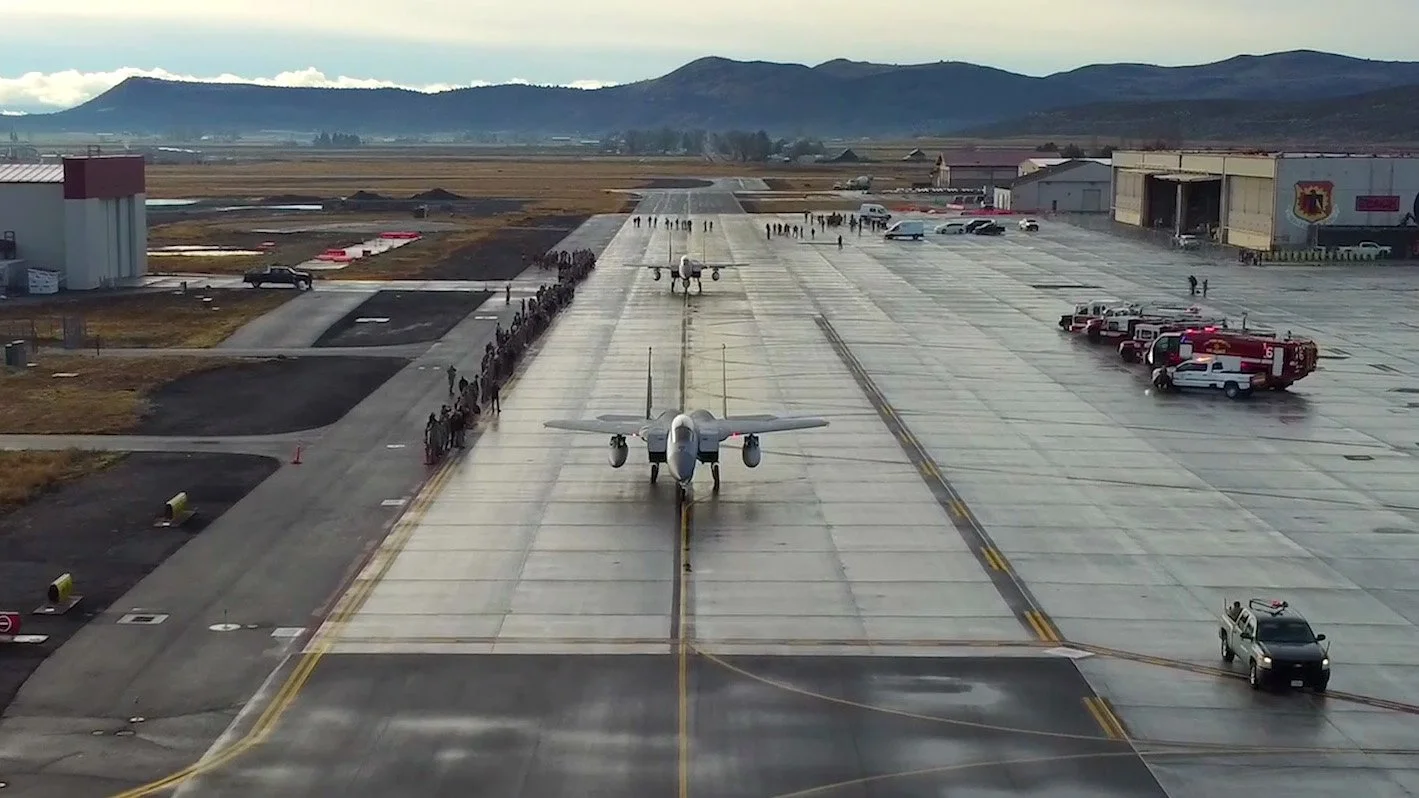
The final two F-15 Eagles assigned to Kingsley Field taxi past assembled 173rd Fighter Wing personnel and emergency vehicles before departing Klamath Falls on Dec. 22, 2025. (Screenshot from “End of the Eagle”/173rd Fighter Wing)
The F-15 era at Kingsley Field ended Dec. 22, 2025, when the final two Eagles assigned to Klamath Falls completed their last taxi and departed the base.
As the aircraft prepared to leave, a pilot delivered a final message over the radio, closing nearly three decades of Eagle operations in Southern Oregon.
““Thank you for the privilege of flying the F-15 at Kingsley Field for 27 unforgettable years. No one has ever flown the Eagle alone.
“To the airmen of the 173rd Fighter Wing, past and present: You are the heart of every mission. From those on the flight line to those working quietly behind the scenes, you turned dedication and sacrifice into trust, excellence and combat power.
“To our families and the Klamath Falls community, thank you for standing with us through every long day, late night and all our homecomings. Your support made this mission possible and gave meaning to everything we did.
“And although this is truly a goodbye, it is not an ending. The F-15 was more than an aircraft. It was a standard that shapes who we are and what we demand of ourselves. Its legacy will always remain at Kingsley Field, paving the way for a future in the F-35.
“The Eagle may no longer fly here, but its spirit, lessons and pride will always carry forward.
“Thank you.””
The aircraft were delivered to NASA’s Armstrong Flight Research Center in California, where they are being used to support supersonic flight research.

Kingsley Field is now moving through a period of transition as the 173rd Fighter Wing prepares for a future F-35A Lightning II training mission.
“End of the Eagle” presents that next chapter not as a departure from the standards established during the F-15 era, but as a continuation of them.





The National Weather Service has issued frost advisories and freeze warnings across parts of Southern Oregon and Northern California as the coldest temperatures of the season arrive. Frost and freezing conditions are expected Sunday and Monday mornings, with possible slick roads in Lake and Modoc counties and sneaker wave danger along the coast.