Oregon Tech Grants Support Healthcare Training, Accessible History Project
New funding from the Roundhouse Foundation and National Park Service will support clinical equipment, medical imaging training and mobile storytelling at Fort Astoria.
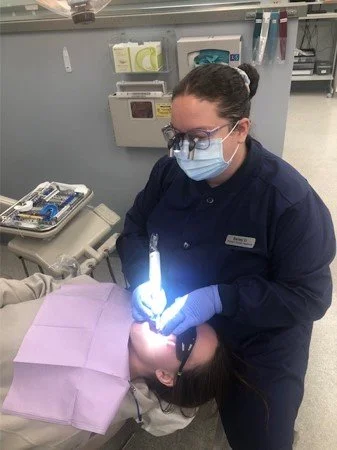
An Oregon Tech Dental Hygiene student uses a SoPro intraoral camera during patient care at the university’s dental clinic. New Roundhouse Foundation grant support will help purchase additional intraoral cameras for Oregon Tech clinics in Klamath Falls and Salem. Photo courtesy of Oregon Tech.
“It is our hope that with the new access to dental and mammography equipment, students will be better prepared to provide health services to Oregonians across the state, especially those in rural and remote areas.”
KLAMATH FALLS, Ore. — Oregon Tech has received two new grants totaling $342,000 to support student training, healthcare access and accessible public history work in Oregon.
The funding includes $142,000 from the Roundhouse Foundation for Oregon Tech’s Dental Hygiene and Medical Imaging programs, along with a $200,000 matching grant from the National Park Service’s American Battlefield Protection Program for a mobile storytelling project at Fort Astoria.
The Roundhouse Foundation support includes $52,000 for dental clinic equipment and a $90,000 matching grant toward the purchase of a new 3D tomosynthesis mammography unit.

In the Dental Hygiene program, grant funds will help purchase prophylaxis handpieces for clinic chairs in Klamath Falls and Salem, along with three intraoral cameras. Oregon Tech said the equipment will support student learning, diagnostics, communication and patient care.
The university’s dental clinics combine clinical education with dental public health outreach projects that serve communities in Oregon and beyond.
The medical imaging portion of the funding will help Oregon Tech purchase its first 3D mammography unit. The equipment will give Medical Imaging students hands-on experience with mammography positioning, quality control and FDA reporting requirements, while also supporting breast cancer awareness outreach.
“It is our hope that with the new access to dental and mammography equipment, students will be better prepared to provide health services to Oregonians across the state, especially those in rural and remote areas,” said Erin Borla, executive director of the Roundhouse Foundation.
Oregon Tech said the Roundhouse Foundation has been a longtime supporter of the university, contributing nearly $800,000 in grant funding to Oregon Tech initiatives, including recent support for a Dental Hygiene Mobile Unit and the Construction Management program.
“The Roundhouse Foundation’s investment will strengthen two programs that directly support rural and frontier healthcare and well-being of communities across Oregon,” said Dr. Ken Fincher, vice president of University Advancement. “By providing advanced clinical equipment and supporting cutting-edge imaging technology, these grants enhance hands-on learning opportunities while helping prepare graduates to meet critical healthcare workforce needs.”
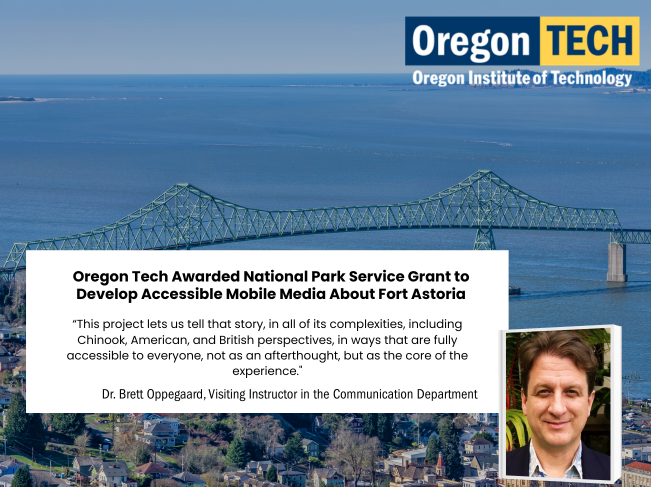
Oregon Tech’s National Park Service grant will support an accessible mobile storytelling project at Fort Astoria, using audio description and geolocated media to share War of 1812 history with visitors and remote audiences. Graphic courtesy of Oregon Tech.
The separate National Park Service grant will support “Battlefield Sound: Using Accessible Mobile Media to Amplify Voices of the War of 1812 at Fort Astoria.”
The project will create an audio-based mobile storytelling experience for the historic Fort Astoria site in Astoria, with a focus on accessibility for visitors who are blind, have low vision or are print-dyslexic.
Fort Astoria was founded in 1811 and is the only War of 1812 battlefield site in the western United States eligible for American Battlefield Protection Program funding, according to Oregon Tech. The university said the site has national significance as the first permanent American settlement on the West Coast, but has had limited interpretation and public visibility.
The project will be led by Dr. Brett Oppegaard, a visiting instructor in Oregon Tech’s Communication Department and a scholar in media accessibility, audio description and mobile storytelling. Oregon Tech said the team will work with partners including the Chinook Indian Nation, the City of Astoria, Lewis & Clark National Historical Park and accessibility consultants.

“Fort Astoria has been overlooked for far too long, given how foundational it is to early American history on the West Coast,” Oppegaard said. “This project lets us tell that story, in all of its complexities, including Chinook, American, and British perspectives, in ways that are fully accessible to everyone, not as an afterthought, but as the core of the experience.”
The finished stories will be delivered through the UniDescription platform, an open-access, geolocation-based mobile system already used at more than 200 National Park Service sites nationwide.
Visitors to Fort Astoria will be able to trigger location-specific audio narratives as they move through the site. Remote audiences will also be able to access the stories online.
Oregon Tech said the multi-year project will include historical research, tribal consultation, script development, prototype testing, on-site evaluation and a public rollout.
Cover image: Oregon Tech students stand with mammography equipment used in the university’s Medical Imaging program. New grant support from the Roundhouse Foundation will help Oregon Tech purchase its first 3D mammography unit, expanding hands-on training for students preparing for healthcare careers. Photo courtesy of Oregon Tech.