ODFW Sets Catch-and-Release Rules for Native Redband Trout in Klamath Basin
Temporary rules begin June 15 on Upper Klamath Lake and several spring-fed creeks to protect declining native trout populations.


KLAMATH FALLS, Ore. — Anglers fishing Upper Klamath Lake and several spring-fed creeks that feed into it will be required to release all native redband trout beginning Sunday, June 15, under a temporary rule change aimed at protecting declining trout populations in the Klamath Basin.
The Oregon Department of Fish and Wildlife said the rule will remain in effect through Oct. 31 and will require catch-and-release fishing for native redband trout. During that period, anglers also will be limited to flies and artificial lures only for all species in the affected waters. Bait will not be allowed.
The temporary rule applies to Upper Klamath Lake, including Pelican Bay, as well as Crystal Creek, Fourmile Creek, Fourmile Canal, Harriman Creek, Odessa Creek, Recreation Creek, Short Creek and Thomason Creek.


ODFW said the change temporarily brings those waters in line with existing regulations on the Wood and Williamson rivers, their tributaries and Agency Lake, where angling is already limited to catch-and-release using flies and artificial lures.
Redband trout are a native inland subspecies of rainbow trout and are managed under “rainbow trout” bag limits and seasons in Oregon fishing regulations.
According to ODFW, biologists observed record-low counts of native redband trout at nearly all spawning locations during the 2025-26 winter spawning season. The agency said ongoing drought, poor lake conditions and other environmental pressures have contributed to recent declines.
The Klamath Basin has experienced repeated prolonged droughts in recent years. ODFW said flows in the Wood and Williamson rivers have trended downward, affecting juvenile redband trout survival and reducing available adult spawning habitat.
The agency also said a significant decline in spawning suckers during the past two years has depleted an important food base for redband trout in the basin.
ODFW officials believe the Klamath Basin may be seeing a delayed effect from earlier drought years, with trout hatched between 2020 and 2022 now returning as spawning adults and showing the heaviest impacts. Biologists are hopeful that fish spawned after 2022 may soon reach adulthood and help strengthen population numbers.
“These are highly unique populations of rainbow trout that are adapted to live in the Klamath Basin, but the constantly changing environmental conditions they are experiencing has resulted in a boom and bust cycle,” said Benji Ramirez, ODFW Klamath District fish biologist. “Unfortunately, we are in the bust phase.”
Ramirez said the temporary rule is intended to help adult redband trout survive the summer and return to spawning areas this winter.
“Our goal is to ensure the long-term sustainability of the population and return to a regular fishing season in the future,” Ramirez said. “But for now, it’s important that we take steps to protect these fish.”
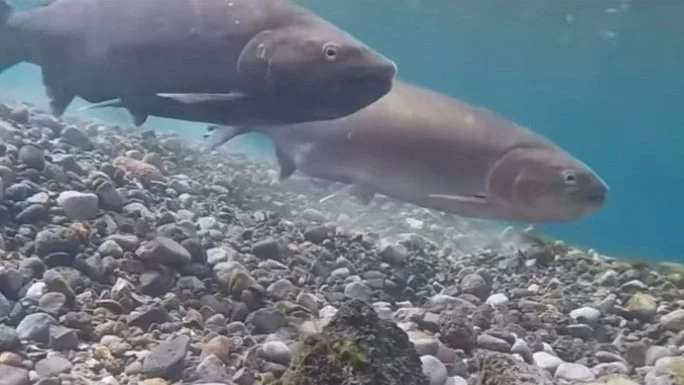
Native redband trout move through clear water in the Upper Klamath Lake watershed in this screen capture from an Oregon Department of Fish and Wildlife video. ODFW says record-low spawning counts and summer water-quality concerns prompted temporary catch-and-release rules beginning June 15. Image courtesy Oregon Department of Fish and Wildlife.
ODFW said water quality in Upper Klamath Lake typically begins to deteriorate in late May or early June, forcing fish to move into cold-water refuge areas in the lake and nearby groundwater-fed tributaries.
Those seasonal movements can concentrate large numbers of fish into smaller areas with better water quality, making them especially vulnerable to angling pressure. Closing harvest during that period is intended to give more adult fish a chance to survive and spawn.
The agency said the angling rule change is one part of broader recovery efforts for native fish in the Klamath Basin. State, federal and nonprofit partners also are working on habitat restoration projects intended to improve water quality and create better conditions for fish and wildlife.

ODFW is encouraging anglers to take advantage of unlimited harvest opportunities for yellow perch, especially in the Williamson River and Crystal Creek. The agency said the Klamath Basin also has strong brook trout fisheries with no harvest limits.
Anglers are reminded to check for in-season regulation changes before fishing.
To improve survival of released fish, ODFW recommends using rubberized nets, keeping fish in the water while removing hooks, avoiding beaching fish, using barbless hooks, landing fish quickly, wetting hands before handling fish, using pliers or a hook-removal tool, supporting fish in the water until they swim away and avoiding fishing during high water temperatures or poor water quality.
Catch-and-release tips
To reduce stress and improve survival of released fish, anglers are encouraged to follow these best practices for catch‑and‑release fishing:
Use rubberized nets to prevent snagging and reduce injury.
Keep fish in the water while removing hooks.
Avoid beaching fish and minimize the time they spend out of the water.
Use barbless hooks to make release quicker and less harmful.
Land fish promptly to prevent over‑exhaustion.
Wet hands before handling fish to protect their slime layer.
Use pliers or a hook‑removal tool to speed up release.
Gently support fish in the water until they swim away on their own.
Avoid fishing during periods of high-water temperatures or poor water quality when fish are already stressed.
Cover image: Native redband trout swim in the Upper Klamath Lake watershed in this screen capture from an Oregon Department of Fish and Wildlife video. ODFW is temporarily requiring catch-and-release fishing for native redband trout on Upper Klamath Lake and several spring-fed creeks beginning June 15. Image courtesy Oregon Department of Fish and Wildlife.


Recent Outdoors