Southern Oregon fires, including the East Evans Creek Fire, were part of a season that surpassed Oregon’s previous acreage record
SEASON SUMMARY
Record acreage statewide
More than 2.5 million acres burned across Oregon in 2026, surpassing the previous statewide record.
ODF response
Approximately 1,023 fires burned 226,557 acres on ODF-protected lands.
Southern Oregon
ODF Southwest Oregon District responded to 210 fires that burned about 17,220 acres in Jackson and Josephine counties.
Largest local fire
The East Evans Creek Fire burned approximately 15,580 acres.
Outside help
ODF brought in 280 resources from 19 states, provinces and territories during the season.
Fire season over
All ODF districts have lifted seasonal fire restrictions, although some local burning rules still apply.
SALEM, Ore. — Oregon’s 2026 fire season has officially ended statewide after more than 2.5 million acres burned across all jurisdictions, surpassing the previous statewide record set just two years ago.
The Oregon Department of Forestry announced Wednesday that all ODF districts have now terminated seasonal fire restrictions, bringing a close to what state officials described as one of the most demanding wildfire seasons Oregon has experienced.
According to the Northwest Interagency Coordination Center, more than 2.5 million acres burned across Oregon during the 2026 season. That exceeds the approximately 1.9 million acres burned in 2024, which had previously stood as Oregon’s record year for wildfire acreage.
The statewide numbers include fires on federal, state, tribal and other jurisdictions and are separate from acreage reported specifically on ODF-protected lands.
On lands protected by ODF, approximately 1,023 fires burned 226,557 acres during 2026. Firefighters held about 93% of those fires to 10 acres or less.
East Evans Creek Fire: Heavy smoke rises from the East Evans Creek Fire during active burning in July 2026. Oregon Department of Forestry.
Southern Oregon part of a much larger season
Jackson and Josephine counties accounted for only a portion of Oregon’s statewide wildfire activity, but the region experienced several significant incidents that reflected many of the challenges firefighters faced across the state.
ODF Southwest Oregon District firefighters responded to 210 fires during the declared fire season, which ran from May 15 through Oct. 28.
Those fires burned approximately 17,220 acres across Jackson and Josephine counties.
Roughly 200 incidents were held to 10 acres or less.
By comparison, the Southwest Oregon District accounted for roughly 7.6% of the acreage burned on ODF-protected lands statewide.
Most of the district’s acreage came from a single incident.
The East Evans Creek Fire started July 10 in Jackson County and ultimately burned approximately 15,580 acres — more than 90% of all acreage burned within the Southwest Oregon District during the declared fire season.
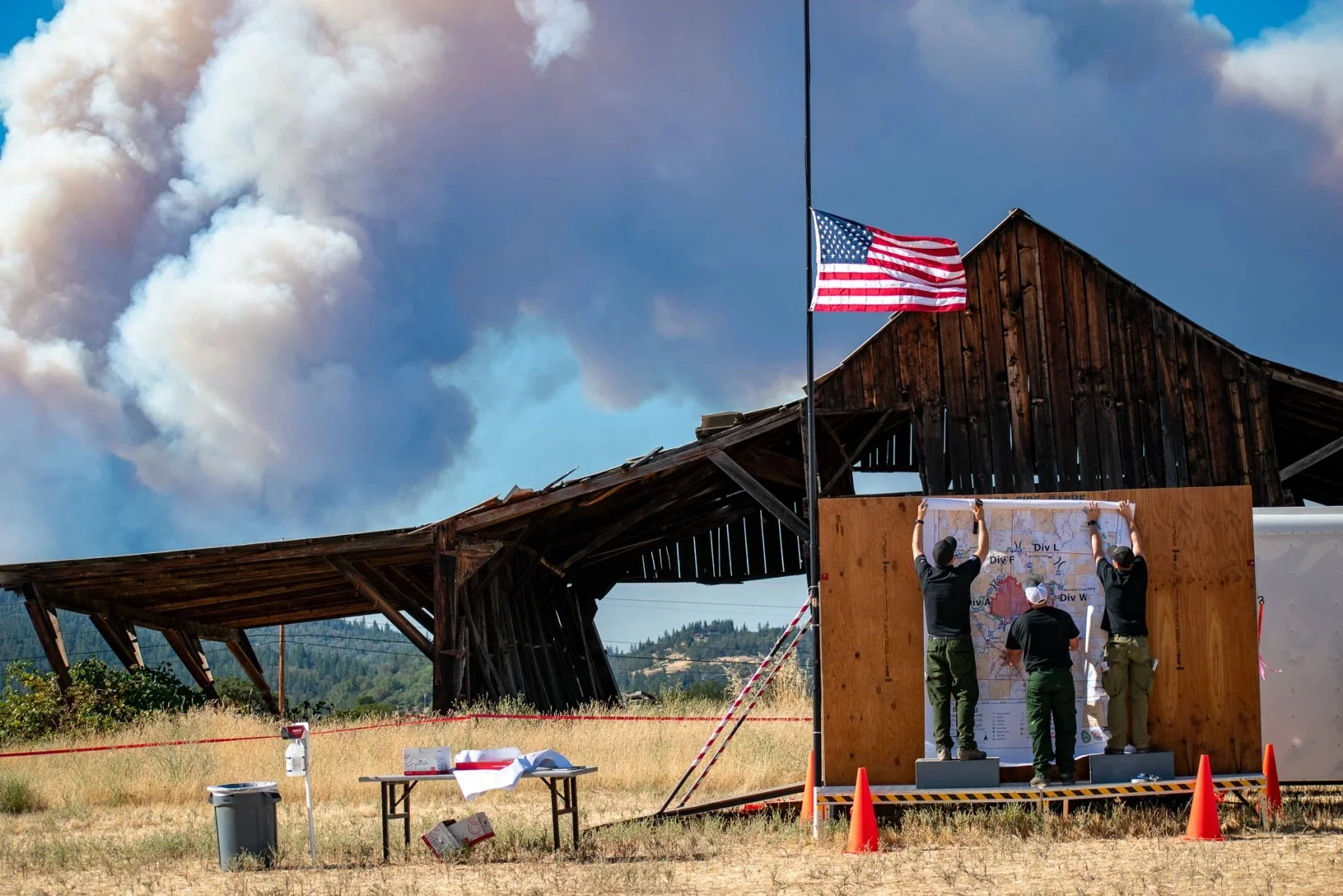
Cover Photo / East Evans Creek Fire Camp: Fire personnel update operational maps at fire camp as a large smoke column rises from the East Evans Creek Fire in Jackson County. Oregon Department of Forestry.
The fire became one of the season’s most significant incidents in Southern Oregon, requiring weeks of suppression work across steep terrain and heavy fuels.
ODF Complex Incident Management Team 1 initially managed the fire before its assignment timed out. A Florida Complex Incident Management Team was then brought to Oregon through a state-to-state mutual aid agreement and assumed command.
That transfer became part of the larger statewide picture of a season that required Oregon to draw heavily on outside assistance.
Air Tanker Operations: An air tanker approaches Medford while supporting wildfire operations in Southern Oregon during the 2026 fire season. Rogue Valley Air Watch.
Resources came from across North America
ODF mobilized outside resources throughout the season as multiple large fires burned simultaneously across Oregon.
In total, 280 resources from 19 states, provinces and territories were brought into Oregon to support wildfire response.
ODF Complex Incident Management Teams were mobilized seven times during the season, in addition to the Florida team assigned to the East Evans Creek Fire.
“This season was one of the most demanding fire seasons we’ve ever experienced,” ODF Deputy Director of Fire Operations Kyle Williams said. “The rapidly-changing and extreme fire conditions again tested the entire system nationwide, but everyone gave it all they had.”
The statewide demand was driven by several factors that developed well before peak summer fire conditions arrived.
A reduced winter snowpack contributed to drought and dry fuels across Oregon. Lightning events, followed by hot, windy weather, then created conditions favorable for new fire starts and rapid growth on existing incidents.
Fielder Mountain Fire: A large smoke column rises above the Fielder Mountain Fire near Rogue River during active fire growth in August 2026. Oregon Department of Forestry.
Local fires reflected statewide conditions
Southern Oregon saw that pattern repeatedly throughout the year.
Wildfire activity began even before the Southwest Oregon District officially declared fire season, with the Carney Flat Fire burning approximately 23 acres on May 9.
The Blackwell Road Fire followed on May 25, with additional incidents in June before fire activity accelerated during July and August.
The East Evans Creek Fire dominated July.
Later in the summer, the Interstate 5 Mile Marker 57 Fire near Grants Pass burned approximately 96 acres, the Woodrat Mountain Fire grew to approximately 288 acres in the Applegate Valley and the Fielder Mountain Fire near Rogue River burned approximately 573 acres.
The season also demonstrated how long wildfire potential can persist.
The Anderson Butte Road Fire burned approximately 78 acres in September, while the West Fork Evans Creek Fire near Sams Valley started Oct. 15 and grew to approximately 283 acres before firefighters secured the perimeter.
Those late-season fires occurred as cooler fall weather was beginning to arrive, underscoring how quickly dry fuels, terrain and wind could still combine to produce active wildfire behavior.
ODF officials said aggressive initial attack remained a core part of the statewide response throughout the season, particularly as hot, dry and windy conditions allowed some fires to grow rapidly.
Aerial Firefighting: An air tanker drops retardant along an active wildfire perimeter during suppression operations in Southern Oregon. Oregon Department of Forestry.
“Safe but aggressive initial attack has been the cornerstone of ODF’s approach to firefighting through the department’s 115-year history,” State Forester Kacey KC said. “While the fire environment has dramatically increased in complexity over the years, we still do all we can to keep fires small to limit the impacts of fire and smoke on Oregonians, communities, and our natural resources.”
Many of the season’s fire starts were contained before they developed into larger incidents, allowing crews to preserve resources for the major fires that required extended suppression efforts.
Wrights Spring Fire: An intense orange smoke column fills the sky near the Wrights Spring Fire in Klamath County during August 2026. Christopher Trotchie.
East-side fires added to the regional toll
The 2026 season was not limited to the Rogue and Illinois valleys. Several significant fires also burned east of the Cascades, where Jefferson Firewatch followed incidents managed through the South-Central Oregon Fire Management Partnership and other interagency partners.
The Wrights Spring Fire became one of the defining fires of the season in Southern Oregon. The fire burned tens of thousands of acres in Klamath County and required a large, prolonged interagency response as crews worked across difficult terrain and changing fire conditions.
The fire also claimed the life of Jason Ensign, 47, of Klamath Falls, who was operating a D-6 dozer for Green Diamond Timber Resource Company during firefighting operations. According to the Klamath County Sheriff’s Office, rapid fire growth and changing conditions cut off Ensign’s escape route near the Yahwee Plateau. His death marked a line-of-duty loss during the suppression effort and became one of the most sobering moments of Oregon’s 2026 fire season.
Picture Rock Fire: Smoke spreads across the rugged terrain of the Picture Rock Fire near Summer Lake in Lake County. Silver Lake Fire District.
In Lake County, the Picture Rock Fire near Summer Lake grew rapidly after starting in August, prompting Level 1, Level 2 and Level 3 evacuation notices and a substantial air and ground response before firefighters were able to secure the fire.
Fire activity on the east side continued into September. The Sycan Fire, approximately 20 miles southwest of Summer Lake, grew rapidly under wind-driven conditions, requiring another significant interagency response in western Lake County.
Together, those incidents illustrate how Oregon’s record-setting season stretched across very different landscapes. While Jackson and Josephine counties experienced major timber and wildland-urban interface fires, Klamath and Lake counties faced large incidents across forests, rangelands and remote terrain — all contributing to the broader statewide fire season.
Fire restrictions lifted, but burning rules remain
With all ODF districts now out of fire season, seasonal ODF fire restrictions have been removed from protected lands statewide.
That does not mean all burning is automatically allowed.
Structural fire agencies may still require permits for residential debris burning, while slash burning requires a permit year-round.
Residents should check local regulations before burning and verify that conditions allow outdoor burning.
ODF districts are now shifting from active fire-season operations toward fuels reduction, wildfire mitigation, prevention work and planning for future seasons.
Although the formal 2026 fire season is over, wildfires remain possible during dry or windy periods throughout fall and winter.


Keep Reading