Critical Water Begins Reaching Klamath Basin Refuges
The deliveries follow weeks of warnings as Basin partners work to protect struggling wetlands without shifting harm elsewhere.
AT A GLANCE
Water deliveries: Critically needed water is now being delivered to Tule Lake and Lower Klamath national wildlife refuges during a crucial period for migratory birds.
Why now: Changing irrigation demands created an opportunity to move available water toward the refuges after weeks of concern over shrinking wetlands and avian botulism.
Collaboration: The effort includes federal agencies, Tribal governments, irrigation districts, agricultural groups, conservation organizations, and local counties.
Bigger picture: The deliveries could help lay the groundwork for a broader flow-through strategy designed to make limited Klamath Basin water benefit agriculture, wetlands, fish, and wildlife as it moves through the watershed.
KLAMATH FALLS, Ore. — Critically needed water is beginning to reach Tule Lake and Lower Klamath national wildlife refuges after weeks of warnings that rapidly drying wetlands were putting one of the Klamath Basin’s most important seasons for migratory birds at risk.
“This is about more than saving ducks. It’s about showing what is possible when people stay at the table, work through difficult issues and respond to changing conditions.”
The water deliveries announced Wednesday by the Klamath Water Users Association are the result of months of discussions among agricultural water users, Tribal governments, conservation organizations, irrigation districts, local counties, and federal agencies.
For a Basin accustomed to fighting over limited water, the agreement represents something less common: a moment when groups with very different responsibilities found enough common ground to act.
“This is the kind of adaptive, collaborative water management we have been advocating for,” said KWUA Board President Scott Seus, a farmer near Tulelake. “When conditions change and an opportunity emerges to put water to work for the broader Basin, we need to be able to act. That is what is happening now.”
The timing is important.


On Aug. 5, Jefferson Daily News reported that thousands of birds had already died at Tule Lake, with wildlife managers estimating roughly 150 deaths each day, while wetlands at Lower Klamath were rapidly drying. Conservation groups were seeking emergency water as conditions became increasingly favorable for avian botulism, and the proposed Tule Lake Flow-Through Pilot was emerging as one possible response.
Earlier this summer, Ducks Unlimited warned that refuge water levels were falling rapidly following a spring that produced more than 100,000 ducklings across the Klamath Basin. As wetlands receded through the summer, concerns grew over shrinking habitat and the increasing threat of avian botulism.
The organization said in late July that it and other Basin partners were working to find additional water for the refuge system before conditions deteriorated further.
California Waterfowl has also spent much of the summer advocating for coordinated water management that would keep water moving through agricultural lands and refuge wetlands rather than treating each need independently.
Now, at least part of that effort is becoming reality.
Mallard family: A mallard hen swims with her ducklings, a reminder of the young waterfowl depending on healthy wetland habitat throughout the Klamath Basin. Caroline Legg/Flickr.
KWUA said changing conditions during the irrigation season created an opportunity for the Bureau of Reclamation and Basin partners to begin directing water toward the refuges.
That opportunity did not come during a year of abundant water.
Klamath Project irrigators entered the 2026 season facing substantial shortages. KWUA estimates approximately 50,000 acres of agricultural land were idled because of reduced water supplies.
As crop demands changed through the summer, however, water managers continued evaluating whether limited supplies could be used differently while still meeting legal requirements for endangered species and other Basin needs.
“This effort shows what is possible when difficult conversations occur and partners remain engaged in finding solutions,” Seus said.
Those conversations have been especially difficult because the ecological problems do not end at the refuge boundary.
In an Aug. 4 statement, The Klamath Tribes said they were “heartbroken” by the loss of migratory birds and emphasized the importance of healthy Tule Lake and Lower Klamath refuges. At the same time, the Tribes cautioned against addressing the refuge crisis by lowering Upper Klamath Lake in ways that could further threaten endangered c’waam and koptu.
Their statement highlighted one of the central challenges of Klamath Basin water management: finding ways to help struggling refuge wetlands without creating additional harm elsewhere in the watershed. The Tribes said solutions should support the health of the Basin as a whole, including both migratory birds and endangered fish.
The current effort includes coordination among Reclamation, federal fisheries agencies, KWUA and its member irrigation districts, Tribal governments, Ducks Unlimited, California Waterfowl Association, local counties, and other Basin partners.
“KWUA appreciates Reclamation and the Trump Administration for bringing people together and working with Basin partners to put adaptive management into practice,” said KWUA Executive Director Elizabeth Nielsen. “This would not have been possible without that engagement and the willingness of everyone involved to work through difficult issues for the broader Basin.”
KWUA did not specify Wednesday how much water is being delivered, how long the deliveries will continue, or how the available water will be divided between Tule Lake and Lower Klamath.
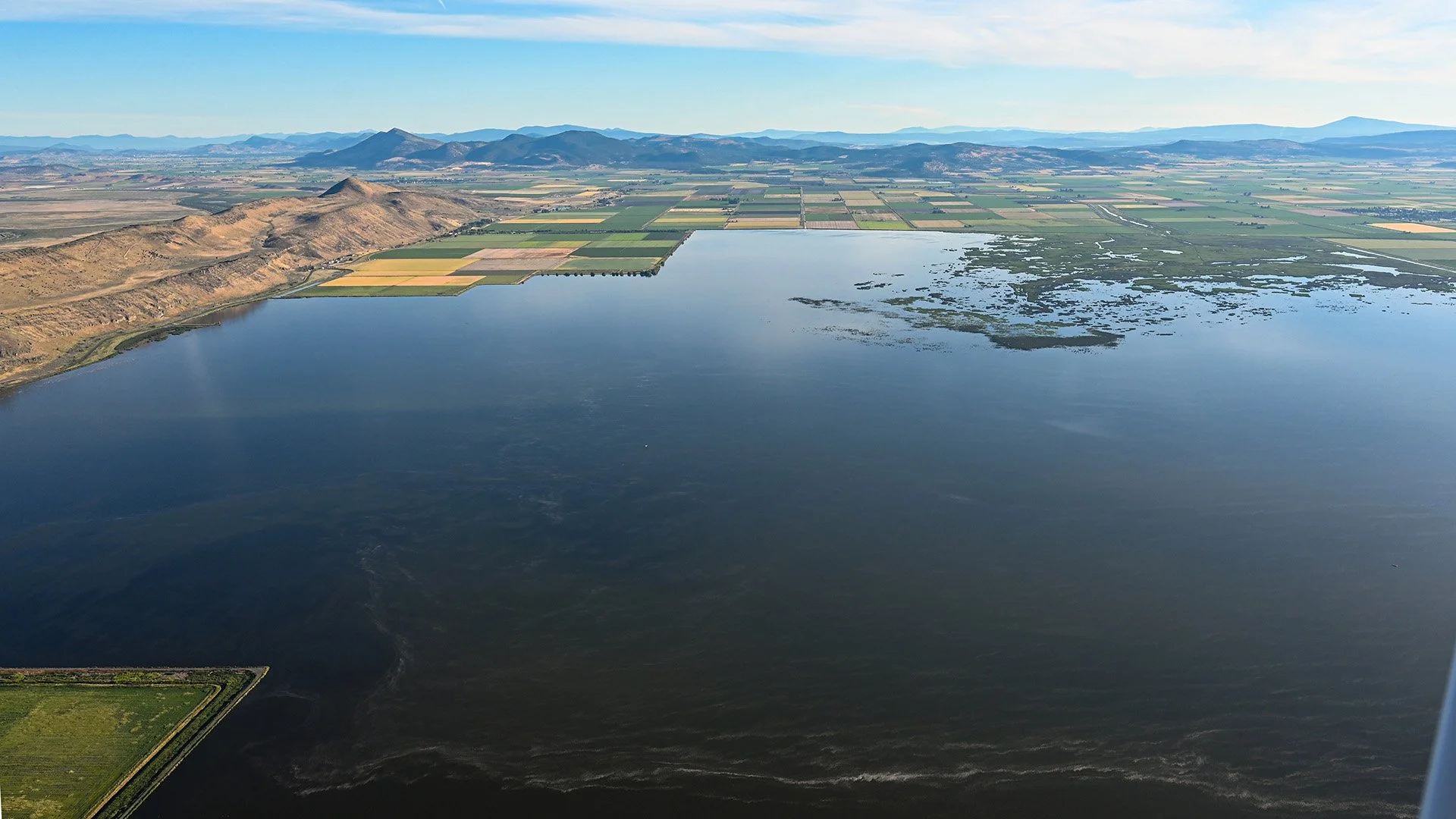
Tule Lake NWR: An aerial view of Tule Lake National Wildlife Refuge shows the close connection between refuge wetlands and surrounding Klamath Project farmland. The proposed Flow-Through concept would use existing infrastructure to move water through agricultural lands and wetlands before returning it to the Klamath River, allowing the same water to provide multiple benefits across the Basin. Chelsea Shearer.
But the water arriving now could also provide an early test of a much larger idea being developed for the Basin.
KWUA and its partners have been working on the proposed Tule Lake Flow-Through Pilot, a concept designed to use existing Klamath Project infrastructure to move water through agricultural lands and refuge wetlands before eventually returning it to the Klamath River.
Rather than using an acre foot of water for only one purpose, the concept seeks to make that water work several times as it moves through the Basin.
Agriculture could use it. Wetlands could benefit from it. Water quality could potentially improve. Fish and wildlife could benefit farther downstream.
The concept remains under development, but KWUA said partners chose not to wait for the broader pilot before addressing the immediate refuge need.

“What we're doing today is an important step toward building the foundation of Flow-Through,” Nielsen said. “The concept has gained tremendous momentum, and we are committed to moving it forward. Right now, the priority is getting water to the refuges.”
For the birds gathering on Tule Lake and Lower Klamath, the larger water policy debate is largely invisible.
What matters is whether there is enough wetland habitat beneath them when they arrive, enough water for young birds that have not yet left the Basin, and enough healthy habitat to reduce the conditions that allow disease outbreaks to spread.
For farmers, the stakes are different but equally tangible. Tens of thousands of acres have already gone without irrigation this year.
Basin Collaboration: Klamath Water Users Association Board President Scott Seus stands with Tule Lake in the background. Seus says the current refuge deliveries show what can happen when Basin partners remain engaged and adapt as conditions change. Klamath Water Users Association file photo.
For Tribes, endangered fish and the health of the broader watershed remain inseparable from decisions made elsewhere in the Basin.
Those competing needs have fueled some of the Klamath Basin’s most enduring conflicts.
Wednesday’s announcement does not resolve them.
But it does show that, under the right circumstances, water management does not always have to end with one part of the Basin winning and another losing.
“We each bring different responsibilities to this watershed,” Nielsen said. “But we share a common purpose: a healthy, resilient Klamath Basin for generations to come.”
Seus said the importance of the effort extends beyond the water currently moving toward the refuges.
“This is about more than saving ducks,” he said. “It's about showing what is possible when people stay at the table, work through difficult issues and respond to changing conditions.”

Keep Reading