A Bigger Home for Second Chances
After nearly a century of animal rescue, the organization is building its biggest future yet.
“Our current building has served thousands of animals over the decades, but it cannot fully support the needs of the animals who rely on us,.”
MEDFORD, Ore. — For nearly 100 years, the Southern Oregon Humane Society has been a place where animals in need find safety and families find new companions.
Now, that mission is preparing to move into a new home.
SoHumane recently broke ground on a new Medford campus that will dramatically expand the organization’s ability to shelter animals, provide veterinary care and connect pets with new families while creating space for education and other community programs.
The June 26 groundbreaking marked a major milestone in a years-long effort to replace SoHumane’s aging Table Rock Road facility with a campus designed specifically around modern animal care.


The future Jed and Celia Meese Campus of the Southern Oregon Humane Society, located at 1959 Commerce Drive, is expected to be completed by October 2027.
Nearly a Century of Caring for Animals
A SoHumane volunteer holds a dog during an outdoor event. The organization provides shelter, adoption and care services for dogs and cats throughout Southern Oregon. (Courtesy of SoHumane)
SoHumane’s roots stretch back to 1928, when Mae Richardson founded the Humane Society of Jackson County as an all-volunteer organization initially serving displaced dogs and horses.
What began as a local effort has grown into one of Southern Oregon’s longstanding animal welfare organizations.
Today, SoHumane provides shelter and adoption services for displaced dogs and cats while supporting spay and neuter efforts, humane education and other programs aimed at strengthening the relationship between people and companion animals.
The organization serves approximately 1,600 animals annually. In 2025 alone, SoHumane reported 1,224 successful adoptions and accepted 1,249 dogs and cats through public intake and its animal transfer efforts. It also provides humane education programs that reach more than 1,000 local schoolchildren each year.
Its work extends beyond animals surrendered locally.
Through programs including its Saving Train initiative, SoHumane accepts animals from other shelters, including dogs and cats facing euthanasia at public shelters in Oregon and Northern California. The organization says animals in its care are not euthanized because they have been at the shelter too long or simply because space is needed.
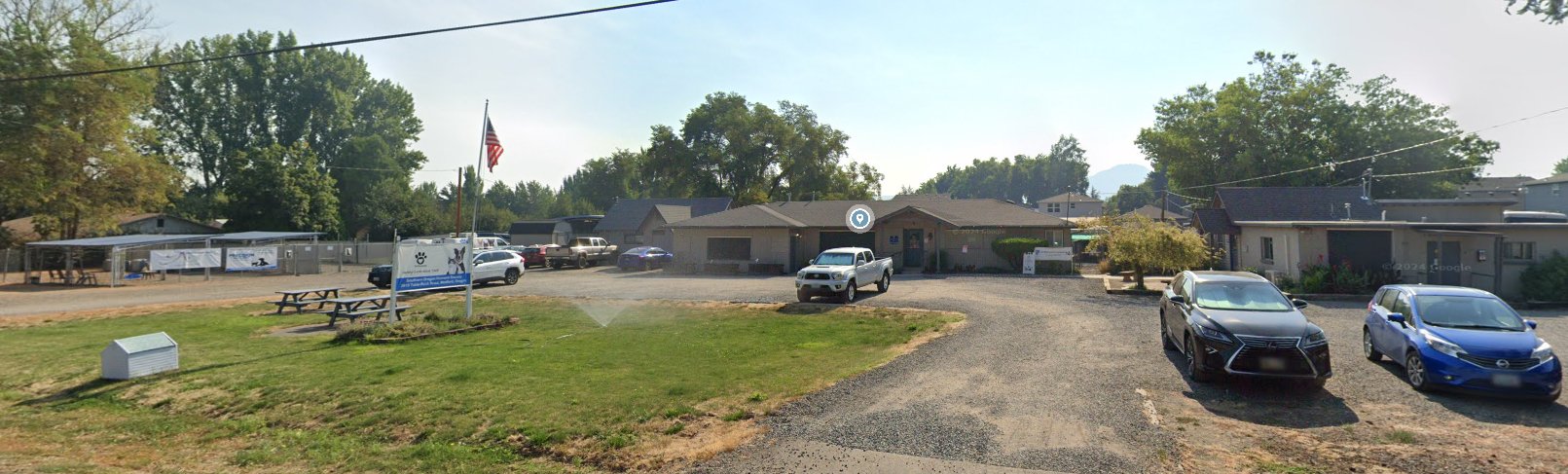
SoHumane’s current facility on Table Rock Road in Medford has served the organization for decades, but its aging design and limited space have increasingly restricted the shelter’s ability to expand services. (Google Street View)
A Facility That Has Reached Its Limits
As SoHumane’s work has grown, its physical home has not grown with it.
The organization’s current Table Rock Road facility has served generations of animals, staff members, volunteers and adopters, but its age and design increasingly limit what the organization can do.
“Our current building has served thousands of animals over the decades, but it cannot fully support the needs of the animals who rely on us,” SoHumane Executive Director Karen Evans said in information released about the project.
The issue goes beyond simply needing more kennel space.
Modern animal shelters are increasingly designed around reducing stress, limiting the spread of illness, providing veterinary treatment on site and creating environments where animals can behave more naturally while waiting for adoption.
SoHumane’s new campus is being designed with those needs in mind.
An architectural rendering shows the planned exterior of SoHumane’s new campus at 1959 Commerce Drive in Medford. The facility is expected to provide expanded animal housing, veterinary care, adoption and community spaces. (Courtesy of SoHumane)
More Space, Less Stress
Conceptual plans for the new campus show a facility built around several interconnected parts of animal welfare rather than simply rows of kennels.
Plans include expanded dog housing and outdoor exercise areas, dedicated spaces for cats and kittens, a catio, adoption and meet-and-greet areas, an education and training center and landscaped outdoor spaces.
The campus also includes significantly expanded medical capabilities, with plans showing a dedicated veterinary hospital, examination and treatment areas, surgery space and a dental suite.
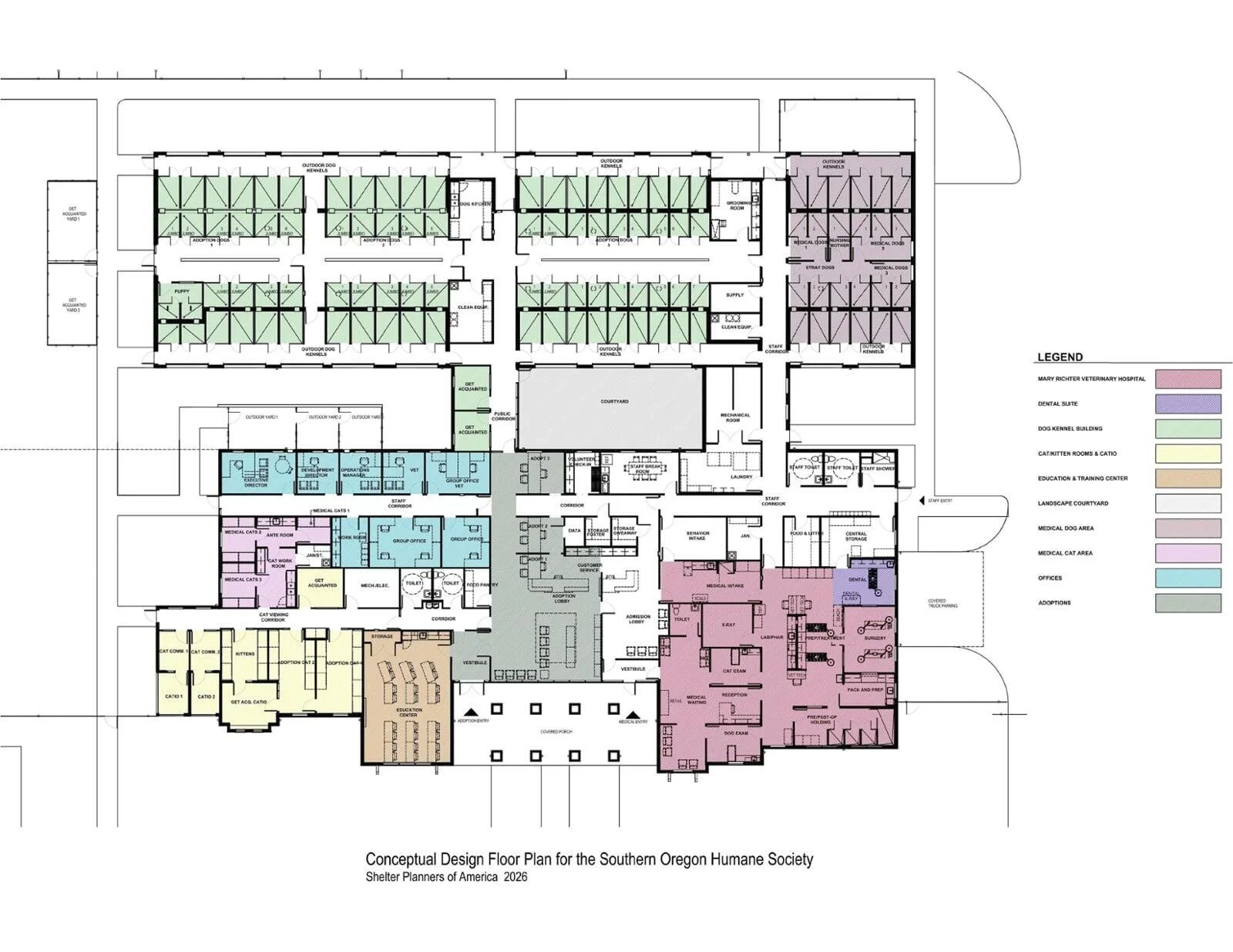
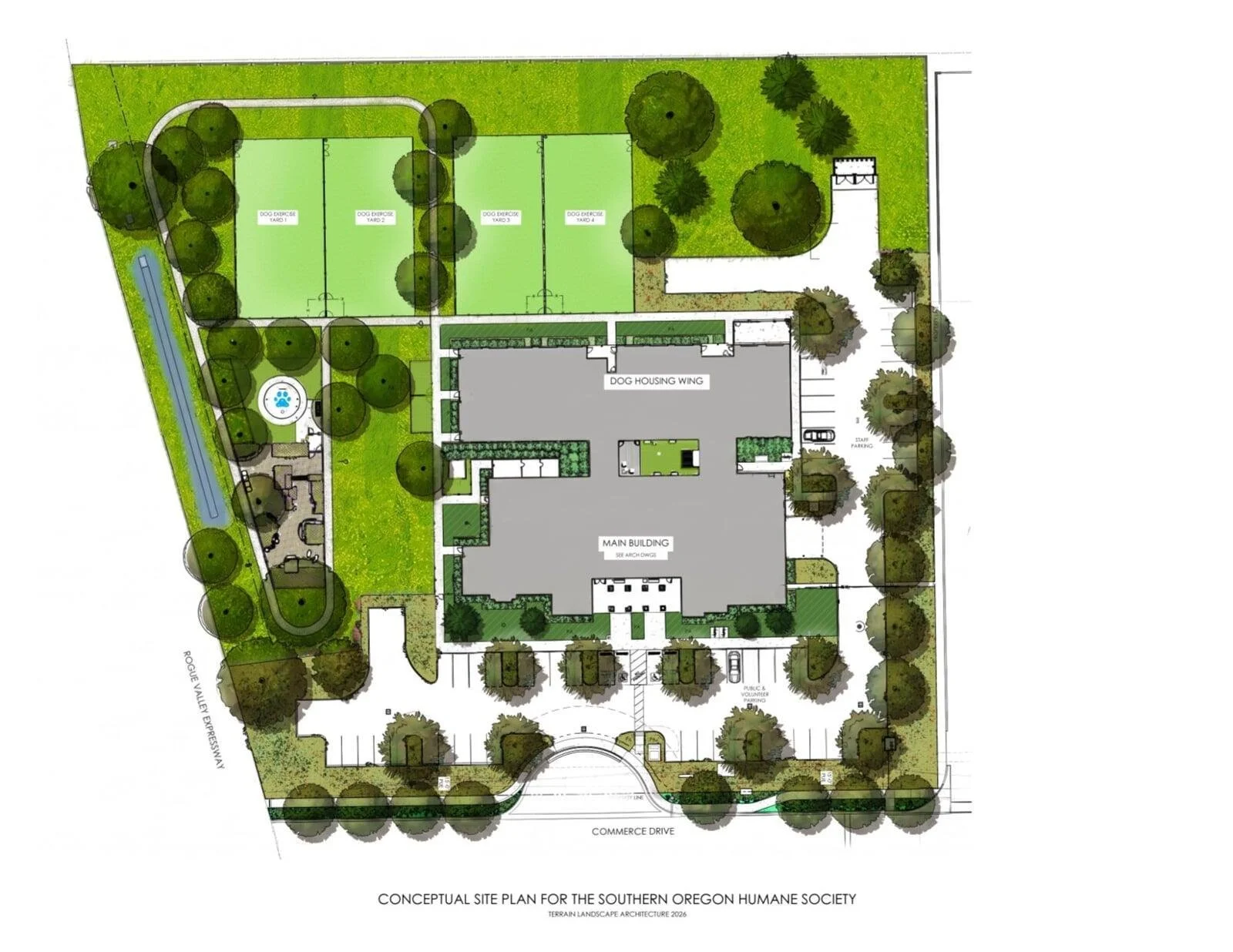
Once completed, the new facility is expected to increase kennel capacity by approximately 50%, while providing quieter and healthier animal housing and more space for veterinary treatment, adoptions, education and community engagement.
The difference could be significant for animals spending days, weeks or sometimes longer waiting for their next home.
A quieter shelter can reduce stress. Better separation between animals can help control disease. Dedicated medical spaces allow treatment to happen more efficiently. Larger adoption and meeting areas can give families a better opportunity to get to know an animal before deciding to bring it home.
Together, those improvements are intended to give SoHumane something its existing facility increasingly cannot: room to grow.

Building a $14.4 Million Future
The new campus is the centerpiece of SoHumane’s “Honoring Our Past — Building Our Future” capital campaign.
Campaign materials list a fundraising goal of $14.4 million, with approximately $8.4 million raised toward that goal.
SoHumane staff and supporters participate in a ceremonial groundbreaking for the organization’s future Jed and Celia Meese Campus in Medford. The new facility is expected to be completed in 2027. (Courtesy of City of Medford)
The City of Medford has also contributed to the effort. In September 2025, the Medford City Council awarded $50,000 in Council Community Initiative Funds to support the project, using revenue generated through local and state marijuana taxes.
The city described the project as an investment in expanded animal services and community resources, with construction planned at 1959 Commerce Drive and completion expected by October 2027.
Private donors, volunteers and community supporters will remain central to completing the larger campaign.
“The support of our community has always been the foundation of everything SoHumane does,” Board President Barb Eaton said. “This campaign allows everyone who believes in rescue, compassion, and second chances to be part of building a facility that will serve Southern Oregon for generations to come.”
What Comes Next
The ceremonial shovels used at the groundbreaking represented more than the beginning of another construction project.
They marked a transition.
SoHumane’s current facility will continue serving animals and adopters while work moves forward on the Commerce Drive campus. At the same time, fundraising will continue as the organization works toward its $14.4 million campaign goal.
When the new doors eventually open, the mission behind them will be largely the same one that began with a small volunteer organization in 1928.
Provide a safe place for animals that need one.
Help them heal.
And, whenever possible, send them home with someone who will make sure they do not need that safe place again.
Nearly a century after that work began, SoHumane is now building the place where it hopes to continue it for generations to come.
SoHumane will host its Purrfect Heart Match adoption event July 24–26 from noon to 4 p.m. at its Medford Adoption Center. Adoption fees will be waived for all cats age 1 and older, giving adult and long-term resident cats a special chance to find the right home. (Courtesy of SoHumane)
Cover image: A dog shares a quiet moment with its owner, reflecting the bond SoHumane works to create and protect through rescue, adoption and animal care across Southern Oregon. (Stock photo by Barnabas Davoti via Pexels)